Current impact of trade tariffs on the global economy
Trade tariffs currently reduce international trade, slow global economic growth and reconfigure value chains, affecting various sectors.
A drop of between 4% and 9% is observed in trade flows, with a significant impact on exports and imports, especially in the United States and its trading partners.
Tariff tensions generate uncertainty, erode investor confidence and put pressure on financial markets, limiting global economic expansion.
Reduction of trade flows and slowdown in global growth
Tariffs drive a notable contraction in global trade and reduce global GDP growth by up to 0.5 percentage points in the short term.
Companies and countries reconfigure their production chains seeking to avoid high rates, displacing production and diversifying markets to mitigate losses.
Increased costs for consumers and companies
Tariffs raise the prices of imported products, making final goods and inputs more expensive, which affects business costs and purchasing power.
This cost pressure translates into increases in consumer prices and lower competitiveness for companies exposed to international markets.
Changes in supply chains and business adaptations
Companies are shifting production stages to countries with lower tariffs and looking for local suppliers to reduce costs and risks.
In addition, they adjust their quality management, regulatory compliance and diversify logistics routes to maintain efficiency and competitiveness in a less favorable environment.
Slowdown in domestic demand in China and its influence on the global economy
Chinese domestic demand slows due to the real estate crisis and consumer uncertainty, affecting global economic growth.
This phenomenon impacts international trade, reducing the demand for raw materials and intermediate goods to global suppliers.
However, government efforts seek to balance this decline with stimuli to sustain the local and global economy.
Factors that slow down domestic demand: real estate sector and consumption
The real estate sector faces structural problems, limiting investment and confidence, while consumption is moderated by economic uncertainty.
Demographics and changes in the economic model also put pressure on domestic demand, making its full reactivation difficult.
Impact on business partners and production chains
The slowdown reduces demand for Chinese exports, affecting its trading partners and generating adjustments in global production chains.
This contributes to greater volatility in markets and influences investment decisions linked to China.
Balance with growth in exports and government stimuli
Despite weak domestic demand, growth in exports and stimulus policies seek to sustain the Chinese economy.
These measures aim to mitigate negative impacts and promote stability in the national and global economy.
Deflation risks in China and global effects
Deflation in China implies a prolonged drop in prices, with low investment and weak domestic demand since 2023. This affects the local and global economy.
Consumer and industrial prices decrease, generating a vicious circle of lower spending, investment and possible prolonged economic stagnation.
Chinese deflation affects global demand for raw materials, slows international trade and generates uncertainty in financial markets.
Deflation such as prolonged price drops and low investment
It is characterized by the sustained fall in prices and excess productive capacity, reflected in negative indices of consumer and producer prices.
This situation limits monetary stimulus, reduces investment and prolongs low economic activity, with persistent signs since 2023.
Effects on consumption, investment and possible prolonged stagnation
Deflation discourages consumption and investment by expecting lower future prices, slowing current spending and investments.
This can lead to prolonged stagnation similar to the Japanese lost decade, with low growth and high preference for savings.
Repercussions for global markets and financial stability
Weak Chinese demand reduces exports and affects suppliers and trading partners, slowing global growth and production chains.
Economic uncertainty and imbalances generate risks for global financial stability and volatility in international markets.
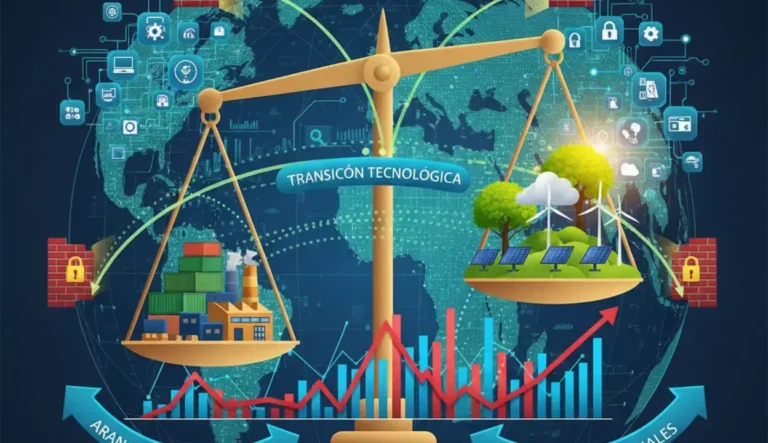
Importance of the green transition and artificial intelligence for the Chinese economy towards 2025
The green transition is key for China to reduce emissions, boost renewable energy and promote sustainable development by 2025.
China aims for a cleaner and more technologically advanced economic model, with clear goals to reduce environmental impact.
This strategy not only meets climate objectives, but strengthens energy security and global leadership.
Strategies to reduce emissions and expand renewable energies
China commits to reducing its net emissions by 7% to 10% by 2035, the first time with an absolute cut target.
The installed capacity of solar and wind will be multiplied by six, exceeding 30% of non-fossil energy in its matrix.
Role of AI in energy efficiency and sustainable digitalization
Artificial intelligence drives efficiency in electrical networks and renewable plants, improving management and predictive maintenance.
China combines cheap renewable energy with AI to reduce energy consumption of data centers and AI systems by up to 90%.
Response of financial institutions and recommended policies to economic challenges
Financial institutions promote market diversification to avoid tariff restrictions and mitigate adverse global impacts.
The technological transition is promoted with investments in renewable energies and support for advanced sectors such as artificial intelligence.
The policies recommend multilateral negotiations to limit tensions, protect local industries and strengthen economic stability.