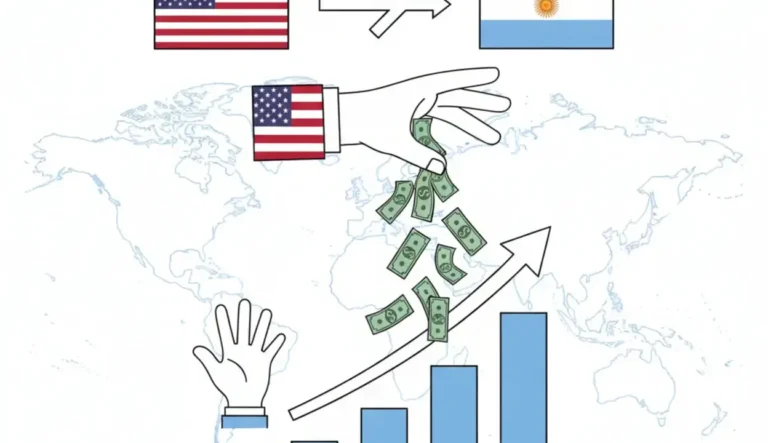
US intervention in Argentina: scope and context
The US intervention in Argentina in 2025 is carried out through a financial agreement for 20 billion dollars, aimed at stabilizing the local economy.
This support is conditional on the electoral success of Javier Milei's party and seeks to strengthen a neoliberal model in the South American country.
The strategy is part of a renewed US policy to strengthen its influence in Latin America vis-à-vis China and Russia.
Details of the operation and political impact
The operation involves a financial package of up to 40 billion dollars and direct intervention in the Argentine exchange market.
In addition, it includes the presence of US political advisors to ensure alignment with current official policies.
Regional geopolitical context and strategic objectives
In 2025, Latin America is the scene of geopolitical competition between the US and China, with Argentina as a US strategic ally.
The US seeks to ensure access to natural resources and strengthen its military and political presence in the region through bilateral agreements.
Immediate and critical economic implications
Financial support aims to stabilize the Argentine peso and contain exchange rate volatility in the face of a deep economic crisis.
However, it generates dependence on the United States and political controversies due to interference in local economic and electoral affairs.
US financial aid to Argentina and its economic impact
In 2025, the US implemented a financial package to stabilize the Argentine economy and support Javier Milei's government in the face of the financial crisis.
This package combines public and private mechanisms, seeking to avoid default and sustain key economic reforms in Argentina.
Its impact includes improvements in reserves, inflation control and conditions for productive and financial recovery.
Components of the financial package and mechanisms used
The package includes an exchange swap of 20 billion dollars between the US Treasury and the Argentine Central Bank, to strengthen reserves.
Additionally, we work with private banks on a line of credit for sovereign debt and direct interventions are carried out in the exchange market.
Effects on inflation, reserves and production
The aid made it possible to contain the depreciation of the peso and reduce inflation associated with exchange volatility, improving economic expectations.
International reserves were strengthened and better conditions were met for the recovery of industrial and agricultural production.
Inflation control and strengthening of reserves
Access to dollars allowed the Central Bank to intervene by selling foreign currency to stabilize the peso and contain inflationary expectations.
Direct purchases of dollars and increased reserves were key to generating investment confidence and sustaining exchange stability.
Challenges and negotiations on continuity of aid
The continuity of support depends on political stability in Argentina and progress in structural reforms required by the US and international organizations.
Ongoing negotiations include redefining private aid, going from 20 billion to a loan of 5 billion, generating uncertainty in future flows.
Expectations and results of the 2025 legislative elections
The legislative elections of October 26, 2025 in Argentina consolidated the leadership of Javier Milei and reconfigured the National Congress.
The La Libertad Avanza party obtained more than 40% of the votes, reaching 64 seats in the Deputies and 19 in the Senate.
This result represents strong support for neoliberal policies and a mandate to continue structural reforms.
Parliamentary renewal and political repercussions
The legislative renewal left La Libertad Avanza as the second minority in Deputies, with extensive control in key provinces.
Peronism lost significant ground, weakening its influence and causing a new distribution of political power.
Impact on economic policy and relationship with the US.
The electoral victory strengthened the government's position to advance liberal economic reforms and market deregulation.
Additionally, it consolidated financial and strategic cooperation with the United States, facilitating key bilateral agreements.
Introduction of the Single Paper Ballot and institutional changes
For the first time, legislative elections used the Single Paper Ballot, modernizing the system and simplifying voting.
This change eliminated multiple party ballots, promotes greater transparency and homogeneous participation throughout the country.
Global macroeconomic events that influence the regional scenario
In December 2025, the eurozone presents inflation of 2.2%, slightly above the ECB's objective, with moderate growth and a solid labor market.
The United States shows annual GDP growth close to 3%, with inflation affected by tariffs and signs of weakening in the labor market.
China projects economic growth close to 5%, with challenges in the real estate sector and more active fiscal and monetary policies.
Key indicators of the Eurozone, USA and China
In the Eurozone, core inflation remains stable at around 2.4%, GDP grows moderately and the unemployment rate is low, at 6.2%.
The United States is experiencing mild quarterly contractions, inflation with increases in goods and services, and a labor market showing mixed signs.
Geopolitical context and effects on international financial markets
The Russia-Ukraine conflict, tensions in Asia and the fragmentation of economic blocs generate high volatility in markets and raw material prices.
International financial markets face growing uncertainty, with currency fluctuations, increases in safe haven assets and trade reconfiguration.
Response of energy markets and policies in Europe
In December 2025, European electricity markets show lower wholesale prices and relative stability, thanks to the increase in renewables and cheap gas.
Energy policy emphasizes the integration of clean energy, despite challenges such as industrial competitiveness and seasonal climate volatility.
Spain stands out for high electricity rates in the electro-intensive industry, promoting discussions on compensation and regulations to improve competitiveness.