Economic impact of agricultural modernization
The agricultural modernization promotes economic development by integrating advanced technologies and optimizing processes in the sector. This improves the productivity and competitiveness of the field.
As a result, the agricultural sector contributes significantly to the GDP and the trade balance, generating positive impacts on other economic activities in the country.
Contribution to GDP and trade balance
In countries like Spain, the agricultural sector represents close to 2.7% of GDP, a value higher than other European economies. This reflects its strategic role in the national economy.
The mechanization and technological innovations facilitate productive growth and opening to international markets, favoring robust exports despite structural challenges.
Increased productivity and competitiveness
Investment in modernization can increase agricultural productivity between 15% and 20%, generating a multiplier effect on the economy by promoting agribusiness and private investment.
Furthermore, the incorporation of modern techniques promotes professionalization and improves the technical and management skills of workers in the sector.
Technologies and processes in agricultural modernization
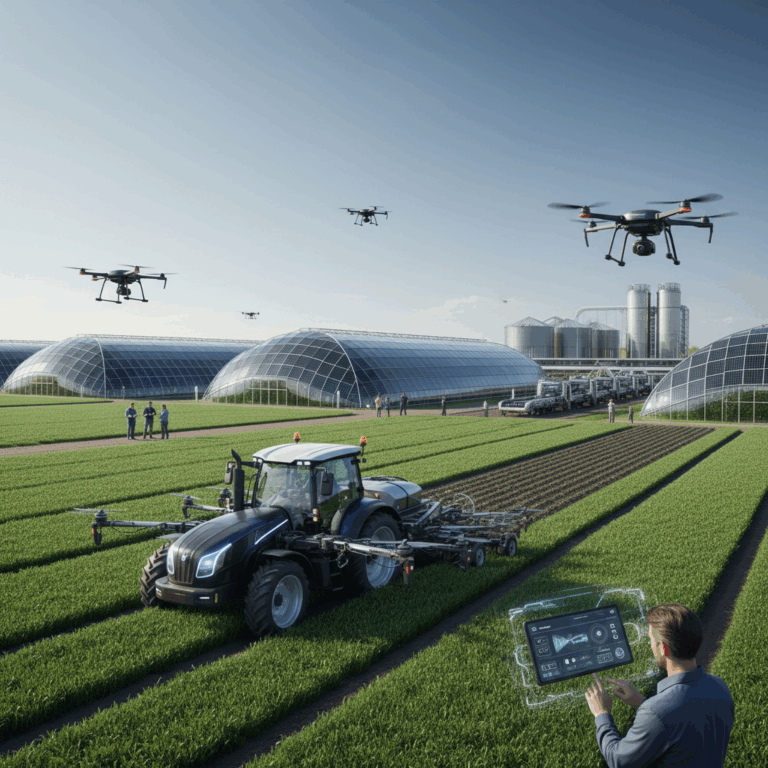
Agricultural modernization incorporates advanced technologies that completely transform the practices of the sector. These innovations facilitate greater efficiency and sustainable production.
Optimized processes and continuous improvement of infrastructure make integration with global markets possible, increasing the competitiveness of the national agricultural sector.
Mechanization and use of advanced technologies
The mechanization it is one of the pillars in the modernization of the field, reducing manual efforts and increasing efficiency in repetitive tasks.
In addition, technologies such as sensors, drones and digital management systems allow crops to be monitored and resources optimized, improving results and sustainability.
These technological solutions promote precision agriculture that minimizes environmental impact and maximizes production, adapting to changing conditions.
Infrastructure improvement and productive optimization
Investment in modern infrastructure, such as efficient irrigation systems and adequate storage, ensures effective resource management and reduces post-harvest losses.
Process optimization improves each productive stage, from planting to distribution, promoting the profitability and quality of agricultural products.
These structural improvements facilitate technical work and strengthen the production chain, benefiting both producers and consumers.
Opening to international markets
Modernization opens the doors to global markets through compliance with international quality standards and required certifications.
This opening favors the diversification of export destinations, increases demand and competitively positions agricultural products in world trade.
Social and structural effects in the field
Agricultural modernization has transformed the social and structural panorama of the countryside, generating significant changes in employment and farm size.
These changes require policies that promote social cohesion and rural sustainability, guaranteeing balanced development and the inclusion of small producers.
Changes in employment and size of farms
Mechanization and optimization have reduced agricultural employment, while increasing the average farm size to improve efficiency.
This process has led to a concentration of the sector, with fewer but more productive farms, which requires new technical skills for workers.
As a result, modern agriculture demands a more specialized job profile, encouraging training and professionalization in rural areas.
Policies for rural cohesion and sustainability
To avoid the exclusion of small and medium producers, it is essential to design policies that promote social and territorial cohesion in the countryside.
These policies must guide modernization towards a sustainable model, respecting the environment and promoting economic and social balance in rural areas.
Future benefits and challenges of the modernized agricultural sector
The modernized agricultural sector it presents great benefits for rural development and the national economy, as well as challenges that require attention for its sustainability.
The generation of added value and social inclusion is essential for balanced growth and fair distribution of benefits in rural areas.
Generation of added value and rural development
Modernization enhances the creation of added value by incorporating technologies that improve the quality and efficiency of agricultural products, favoring rural development.
This boosts local agribusiness, generates qualified employment and strengthens the economy in rural regions, contributing to reducing depopulation and promoting social innovation.
Furthermore, sustainable rural development is achieved by integrating agricultural production with complementary services and activities, consolidating more resilient territories.
Inclusion and equitable distribution of benefits
To guarantee a fair modern agricultural sector, it is crucial to implement policies that promote the inclusion of small and medium producers, avoiding their exclusion.
Equitable benefit distribution strengthens territorial and social cohesion, ensuring that progress is not concentrated only on large farms or urban areas.
Thus, modernization must be sustainable and inclusive, balancing economic efficiency with equity and protection of rural areas for the future of the sector.