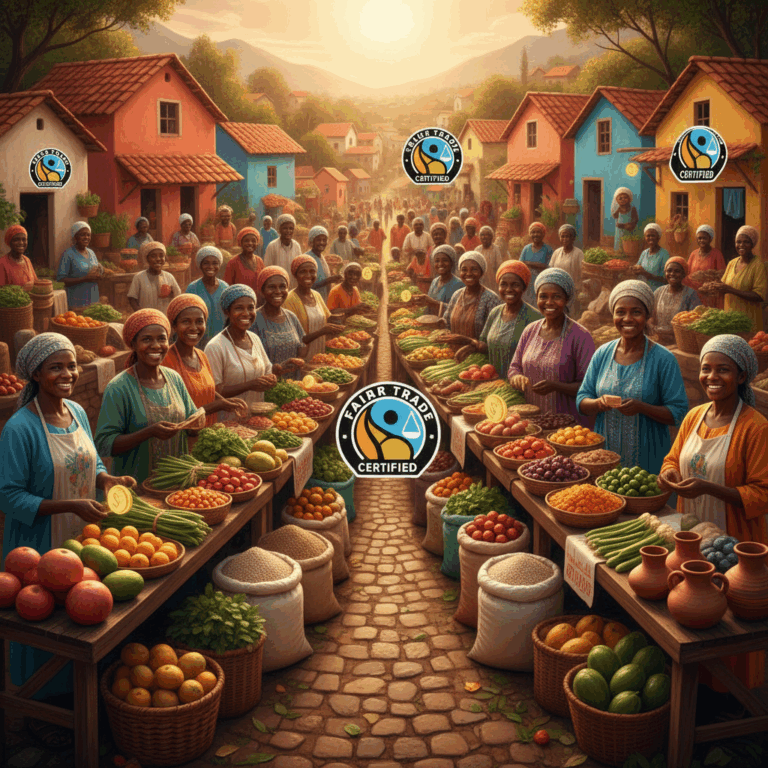
Direct benefits for producers
The fair trade it guarantees small producers and workers stable prices and fair working conditions, essential for their well-being and development.
This system also offers additional premiums that allow investment in social projects, promoting significant improvements in the quality of life of these rural communities.
Price stability and working conditions
Fair trade ensures fair and stable prices, protecting producers from market volatility and frequent economic crises.
In addition, it promotes decent working conditions, including labor rights, job security and adequate wages, improving the quality of life of workers.
This balance contributes to economic and social sustainability, making it easier for producers to plan and develop their long-term activities with greater safety.
Access to markets and premiums for social projects
Fair trade certified producers access international markets that value their products, increasing their sales and growth opportunities.
The premiums obtained are allocated to social projects that improve basic services such as health, education and housing, reinforcing community development.
This additional funding allows communities to invest in their collective well-being, promoting a positive impact that goes beyond the economic sphere.
Impact on the organization and community
Fair trade promotes an internal transformation in productive organizations, encouraging the active participation of its members in decision-making.
In addition, it strengthens social cohesion and improves technical capabilities, which contributes to more sustainable and equitable community development.
Democracy and empowerment in cooperatives
Cooperatives under fair trade adopt democratic practices, giving voice and vote to all producers in the management and distribution of benefits.
This empowerment reinforces the autonomy of communities, promoting inclusive leadership that respects diversity and strengthens unity.
Active participation also increases social responsibility and commitment to common objectives, achieving a positive impact on the environment.
Training and improvement in quality and productivity
Fair trade facilitates access to technical training, improving producers' skills to raise the quality of their products.
These trainings promote more efficient production processes, increasing competitiveness and added value in the national and international market.
Continuous improvement builds trust among consumers and ensures the economic sustainability of the communities involved.
Strengthening the social fabric
Activities linked to fair trade strengthen social networks within communities, creating links of collaboration and mutual support.
This robust social fabric facilitates joint problem solving and encourages collective initiatives that improve local living conditions.
Thus, more resilient communities are built with greater capacity to face economic and social challenges in an integrated manner.
Contribution to the development of the local economy
The fair trade promotes sustainable local economic development, reinforcing the rural economy and generating stability in producing communities.
By strengthening organizational structures and reducing external dependence, it helps retain valuable resources that directly benefit producers and their regions.
Retention of resources and reduction of intermediaries
One of the main advantages of fair trade is reduction of intermediaries, which increases direct income to producers.
This allows more resources to remain in rural communities, favoring savings, investment in local projects and social development.
By reducing the distribution chain, fairer prices are generated and the economic autonomy of small producers is strengthened.
Improvements in food security and economic stability
Fair trade contributes to the food security by stabilizing the income of peasant families, guaranteeing access to basic foodstuffs.
This economic stability reduces vulnerability to crises and allows planning improvements in production and quality of life.
In addition, it strengthens the capacity of organizations to promote local development that benefits the entire community.
Social effects and sustainability
Fair trade contributes significantly to limiting migration by strengthening rural communities, offering economic and social stability for their inhabitants.
In addition, it promotes regional development by strengthening production organizations, which become key agents of local progress.
This system promotes the construction of inclusive and resilient economies, promoting equity, sustainability and active participation of all social actors.
Limitation of migration and regional development
Fair trade offers economic opportunities that reduce the need to migrate from the countryside to the city, keeping families in their communities.
By strengthening local capacities and resources, more balanced regional development is promoted that is closer to cultural and social realities.
This dynamic contributes to preserving human capital in rural areas and consolidating more solid and participatory social structures.
Building inclusive and resilient economies
Participating in fair trade boosts local economies that incorporate marginalized producers and workers, promoting social inclusion.
Resilience is built through sustainable production systems that better address economic and environmental crises.
Thus, environments are generated where communities can prosper, adapt and grow sustainably and fairly over time.