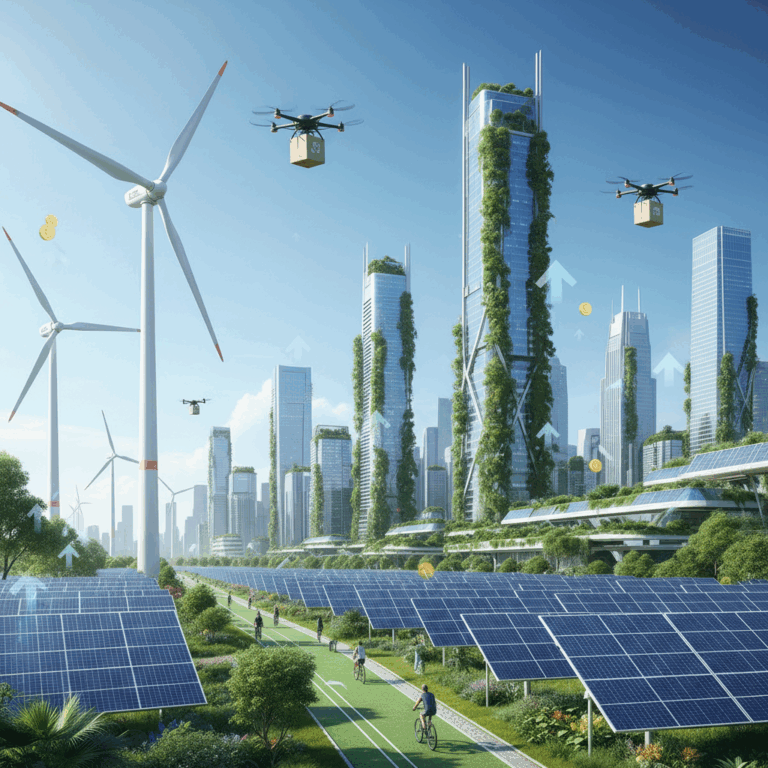
Economic benefits of clean energy
The clean energy they represent an opportunity to improve the economy through cost reduction and sustainable development. Its implementation promotes economic growth articulated with environmental care.
In addition, these renewable sources provide stability and predictability in energy consumption, key aspects for companies and communities seeking to maintain secure long-term financial planning.
Long-term cost reduction
The initial investment in renewable energies, such as solar or wind, may be high, but their operating costs are minimal, since they use free and inexhaustible natural resources.
This allows one significant decrease in energy bills for homes and businesses, in addition to protecting against fluctuations in fossil fuel prices.
Cost reduction promotes a more stable economic environment and facilitates financial planning, promoting economic and environmental sustainability.
Employment generation and local development
The clean energy sector generates a wide variety of direct and indirect jobs from construction to the maintenance of sustainable infrastructure.
This job creation drives local development, strengthening both urban and rural economies and promoting social stability.
Furthermore, the demand for new professional profiles in renewable technologies stimulates training and job diversification, favoring inclusive economic growth.
Ecological innovation and its economic impact
The ecological innovation it is essential to drive sustainable economic growth, integrating clean technologies that improve efficiency and reduce environmental impact.
This technological progress generates a profound change in the economy, promoting emerging sectors and strengthening global competitiveness through sustainable solutions.
Adopting these innovations not only improves productivity, but also opens opportunities for diversification and expansion in international markets.
Development of sustainable technologies
The development of sustainable technologies it involves the creation of systems that take advantage of renewable resources with greater efficiency and less pollution.
These innovations encourage clean production and allow access to renewable sources such as solar, wind and green hydrogen, essential for the future.
In addition, they promote industrial modernization and the responsible use of resources, consolidating an economy that respects environmental limits.
Investments and international competitiveness
Investments in ecological innovation attract capital and position countries as leaders in green sectors, enhancing their international competitiveness.
Global companies allocate resources to electrification projects, smart networks and clean technologies, strengthening the trade balance and economic resilience.
This dynamic promotes a more innovative market, capable of responding to the growing demand for sustainable solutions worldwide.
Opening of new markets
The green economy drives the opening of new markets for sustainable technologies and services, facilitating export and green international trade.
This expansion generates opportunities for entrepreneurs and companies, diversifying the economic offer and contributing to inclusive and sustainable development.
Interesting fact
The global clean technology market is growing at an annual rate of more than 20%, reflecting the constant increase in demand and investment in green innovation.
Energy stability and security
The energy stability it is key to sustainable economic development, allowing better financial planning and reducing risks associated with price volatility.
Likewise, energy security strengthens the independence of countries, minimizing vulnerability to international crises and promoting stable economic development.
Predictability in energy costs
Renewable energies offer greater predictability in energy costs because they use free and constant resources, such as the sun and the wind.
This stability allows companies and households to plan their expenses with greater certainty, avoiding the fluctuations that characterize fossil fuels.
In addition, it reduces uncertainty in the markets, facilitating long-term investments and strengthening the local and national economy.
Reduction of dependence on imported resources
The transition towards clean energy contributes to reduce dependence on imported energy resources, strengthening the energy sovereignty of countries.
This improves national security and reduces exposure to geopolitical conflicts or abrupt variations in international prices.
By promoting the use of local and inexhaustible resources, the internal economy is promoted, generating employment and sustainable development.
Integration of the economy and environmental sustainability
The integration of the economy with environmental sustainability allows for harmonious development that benefits both society and the planet. This approach drives responsible and lasting growth, balancing economic and ecological interests.
In this way, countries manage to move towards a low-carbon economy that favors the conservation of natural resources, improving the quality of life and ensuring a resilient future in the face of environmental changes.
Climate change mitigation and environmental improvement
Adopting green technologies significantly reduces greenhouse gas emissions, helping to mitigate climate change and protect vital ecosystems.
This process also improves air, water and soil quality, creating a healthier environment for communities and promoting the preservation of biodiversity.
The green economy thus promotes responsible practices that minimize pollution and optimize the use of natural resources, ensuring long-term environmental sustainability.
Impact on health and reduction of associated expenses
The promotion of clean energy and the reduction of atmospheric pollutants contribute to improving public health, reducing respiratory and cardiovascular diseases.
This benefit translates into lower spending on health systems and greater labor productivity, which strengthens the economy and social well-being.
In this way, the green economy not only protects the environment, but also generates significant savings and improvements in the quality of life of the population.