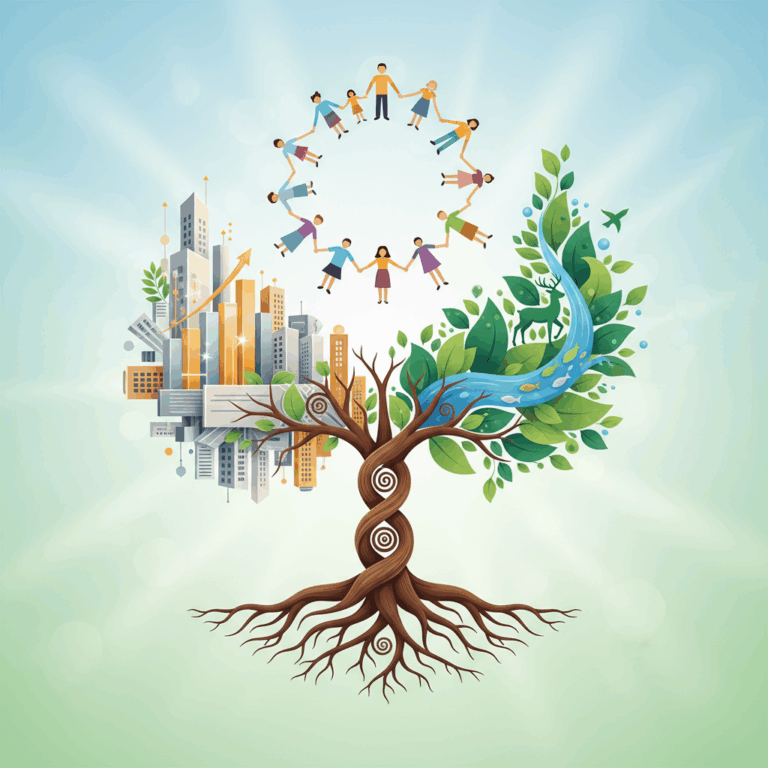
Fundamentals of sustainable development
Sustainable development seeks a crucial balance between economic growth, environmental protection and social well-being to meet current needs. This approach integrates interests that often seem opposite, ensuring a viable future.
This balance allows natural resources to be preserved and opportunities for future generations not to be compromised. It is the basis for a harmonious coexistence between economy, society and nature.
The foundations of sustainable development imply a long-term vision that promotes social justice, environmental respect and economic progress together, creating a development model that benefits everyone.
Balance between economic growth, environment and society
The core of sustainable development lies in balancing economic growth with environmental conservation and social improvement. This harmony is essential to avoid irreversible negative impacts.
Maintaining this balance ensures that economic activities do not deplete natural resources or damage biodiversity, thus promoting responsible and sustainable practices.
Furthermore, social well-being is strengthened when communities have equitable access to services and participate in decisions that affect their environment, generating inclusive development.
Importance for present and future generations
Sustainable development ensures that current decisions do not compromise the ability of future generations to meet their own needs and enjoy a healthy environment.
This intergenerational responsibility involves protecting vital resources and promoting a balance that prevents overexploitation and long-term environmental degradation.
Thus, a legacy of progress and environmental respect is built that benefits not only the present, but also those who will inherit the planet.
Environmental and economic advantages
Sustainable development offers key benefits to the environment and economy, promoting practices that protect resources and foster responsible growth. These advantages contribute to a more balanced and prosperous future.
Integrating sustainability within economic sectors drives innovation and improves efficiency, positively impacting environmental preservation and business competitiveness. These benefits are fundamental for resilient development.
Furthermore, these advantages support the creation of green jobs and encourage the rational use of resources, which strengthens economic stability and the long-term health of the planet, ensuring social and environmental well-being.
Preservation of natural resources and biodiversity
Sustainable development protects natural resources by promoting the responsible use and conservation of ecosystems. This is vital to maintain biodiversity and avoid environmental degradation.
Preservation reduces pollution, mitigates climate change and reduces deforestation, preserving ecosystem services essential for human life and the economy.
Practices such as the efficient use of energy and the development of green infrastructure contribute to reducing the ecological footprint and guarantee resources for future generations.
Promotion of jobs and technological innovation
The sustainable approach generates new job opportunities in sectors linked to renewable energy, environmental management and clean technologies, boosting the local and global economy.
In addition, it promotes technological innovation, promoting solutions that optimize production processes and minimize negative impacts, promoting a more responsible and competitive economic transformation.
This combination strengthens economic resilience and creates an environment conducive to inclusive growth, where employment is linked to environmental protection and social development.
Optimization of resources and competitiveness
Efficient resource management reduces operating costs in companies and communities, improving productivity and minimizing waste. This optimization is key to economic sustainability.
By integrating sustainable practices, organizations increase their competitiveness, responding to demands from conscious markets and stricter environmental regulations.
This advantage contributes to financial stability and strengthens the ability to adapt to environmental or economic crises, ensuring lasting development.
Social benefits of sustainable development
Sustainable development promotes social justice and equity, ensuring that all people have access to fundamental services. This approach seeks to reduce inequalities and improve quality of life.
In addition, it encourages the active participation of the community in decisions that affect its environment, which generates inclusive and effective solutions for collective well-being. Collaboration strengthens the social fabric.
Justice, equity and access to fundamental services
Justice and equity are pillars of sustainable development, as they ensure that no one is excluded from essential benefits such as health, education and decent housing. This is key to eradicating poverty.
Guaranteeing access to basic services improves the quality of life and promotes social cohesion, contributing to more just and stable societies. Equity drives equal opportunities for all citizens.
Furthermore, social participation encourages communities to express their specific needs, strengthening adapted and fair local management that favors comprehensive and sustainable development.
Implications and practical application
Social responsibility becomes a fundamental pillar to improve the quality of life, integrating values that promote solidarity and constant community participation.
The practical application of sustainable development demands a proactive commitment that ensures healthy and equitable environments for all individuals, today and in the future.
This approach strengthens collective well-being, promoting harmonization between human needs, environmental care and efficient and fair economic development.
Social responsibility and quality of life
Social responsibility implies that individuals, companies and governments act with ethical awareness, promoting actions that benefit the environment and the community. This improves the quality of life in a comprehensive way.
A responsible society promotes social justice and equitable access to basic resources such as health, education and public services, which reduces social vulnerabilities and inequalities.
Likewise, by taking care of the natural environment, cleaner and safer spaces are created, contributing to greater physical and emotional well-being of the population, strengthening the sense of belonging and social cohesion.
Requirements to implement a sustainable model
To carry out a sustainable model, a firm political commitment is necessary, with public policies that integrate economic development, environmental protection and social justice.
Furthermore, the active and conscious participation of civil society is key, since inclusive decisions tend to be more effective and adapted to local realities.
Finally, it is essential to have environmental and technological education that promotes innovation and the optimal use of resources, facilitating the transition towards sustainable practices in all sectors.