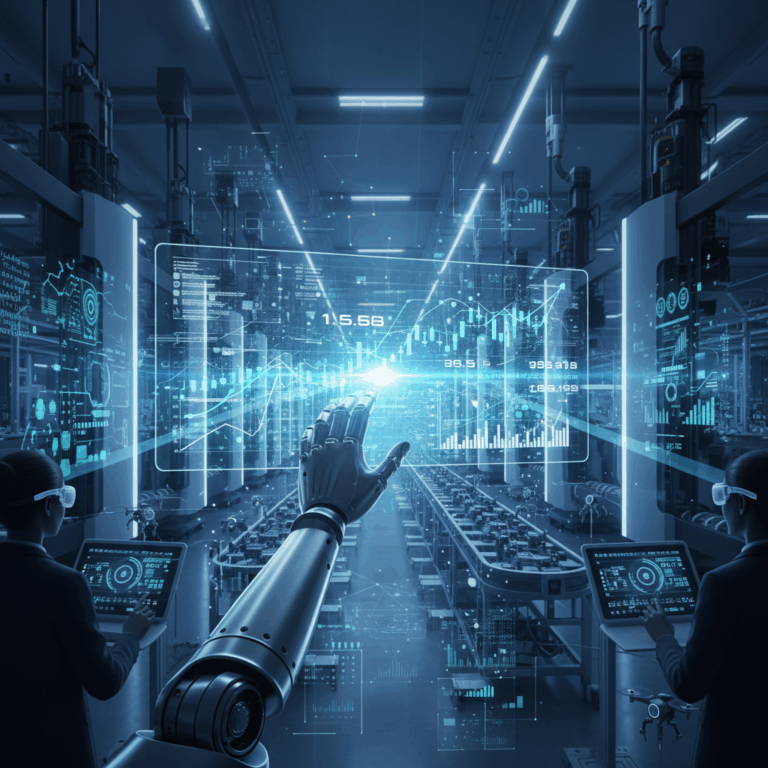
Technological transformation in the economy
The Industrial Revolution 4.0 drive radical change in the economy through automation and intensive use of advanced technologies. These changes increase efficiency and productivity.
The business sector adopts intelligent systems capable of operating autonomously, which optimizes processes and allows large-scale customization. This revolutionizes traditional production models.
Automation and smart factories
Automation redefines factories, now equipped with sensors and robots that work together to improve production. This reduces errors and downtime significantly.
Smart factories enable efficient management and solve problems in real time, promoting optimal use of resources and more sustainable and flexible production.
Integration of AI and interconnected systems
Artificial intelligence connects systems through the Internet of Things, facilitating autonomous decision-making based on analysis of large volumes of data.
These interconnected systems improve the adaptability of companies to the market and promote innovation by anticipating demands and optimizing the production chain.
Labor impact of the revolution 4.0
The Industrial Revolution 4.0 it has a double impact on the world of work: it generates both challenges and opportunities. Automation and AI are transforming the nature of employment.
It is crucial to understand how technology displaces certain jobs but also creates new professional areas, requiring constant adaptation of workers and skills.
Job displacement effect
Many repetitive and administrative tasks are being replaced by machines and algorithms, leading to job losses in automatable sectors.
According to estimates, up to 49% of current jobs may disappear, especially in manufacturing and routine activities, generating uncertainty in the labor market.
This phenomenon forces us to reconsider the distribution of work and income, affecting the stability and growth of certain traditional professions.
Job creation and new skills
The technology also creates jobs in areas linked to the digital economy, such as data analysis, AI programming and maintenance of automated systems.
The demand for skills related to creativity, problem solving and technological management is increasing, promoting professional development and continuous training.
These jobs require advanced skills and foster innovation, changing the way we collaborate and produce within modern organizations.
Collaboration between humans and machines
In the new work reality, humans and machines work together, combining artificial intelligence with human creative and critical capacity.
This cooperation enhances the added value of tasks, where machines take on repetitive tasks and humans focus on strategic and creative activities.
Competitive advantage with technological collaboration
Companies that efficiently integrate this collaboration achieve greater productivity and adaptability, positioning themselves better in increasingly dynamic markets.
Economic and productive changes
The industrial revolution 4.0 drives profound transformations in production and economic processes, accelerating digitalization and automation. These innovations multiply responsiveness and efficiency.
This environment allows companies to offer increasingly personalized products, adapting to specific consumer demands and improving competitiveness in globalized markets.
Improvement in productivity and customization
Automation and real-time data analysis optimize resource use and reduce errors, significantly increasing productivity in production chains.
In addition, advanced manufacturing makes it possible to adapt products to individual needs, increasing customer satisfaction and promoting innovation in design and services.
This massive customization translates into greater added value and the generation of new opportunities for the industrial and commercial sectors.
Optimization of processes and decision making
Sophisticated analysis of large volumes of personal and production data allows you to anticipate trends and adjust operations quickly, optimizing costs and results.
Artificial intelligence facilitates automated and accurate decision making, reducing uncertainty and improving strategic planning in organizations.
This comprehensive optimization transforms the way companies manage their resources and adapt to the competitive environment.
Challenges and social adaptations
The Industrial Revolution 4.0 requires rapid social adaptation to respond to the labor and economic transformations caused by technology. Educational systems must be reinvented.
Social security faces challenges to protect workers in changing jobs and emerging economies, highlighting the need for inclusive and up-to-date policies.
Training and social security
Continuous training is crucial to maintain employability in a labor market that values new technological skills and the ability to constantly adapt.
Social security systems must evolve to more flexible models that cover both traditional jobs and new digital and self-employed jobs mediated by technology.
Investing in technology education and career retraining programs reduces the gap between market demand and workforce skills.
Structure and flexibility of the labor market
The labor market becomes more dynamic and flexible, with the emergence of modalities such as teleworking, temporary jobs and digital platforms, requiring adequate regulation.
The balance between flexibility and labor protection is essential to avoid precariousness and guarantee rights, promoting safe and sustainable work environments.
Societies will need to adjust their legal framework and labor policies to accompany this transition and take advantage of the opportunities of an automated and interconnected economy.