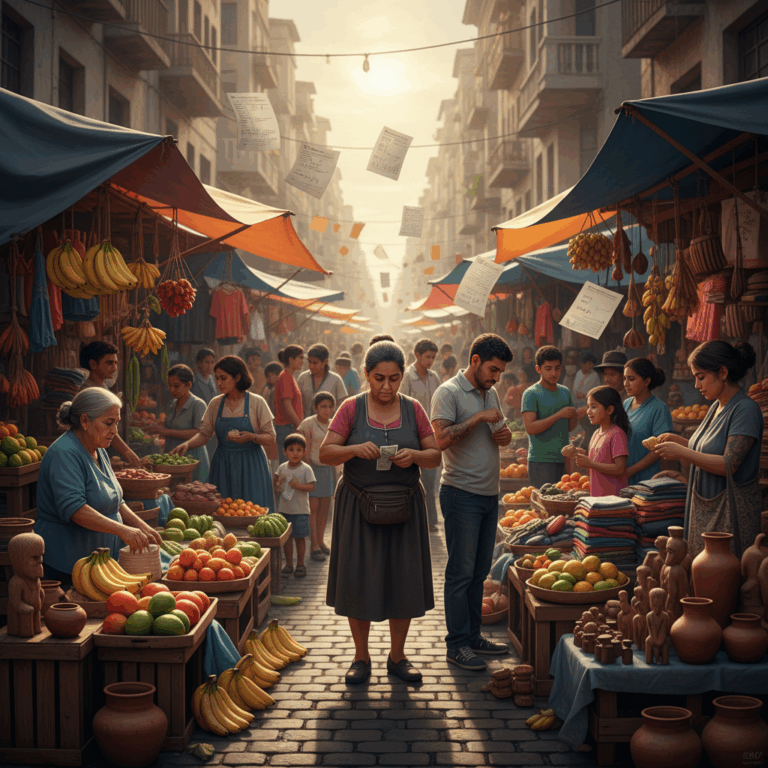
Definition and context of the informal economy
The informal economy it covers productive activities that generate income but operate outside of state regulation. Characterized by the lack of records and contracts, these activities are common in developing countries.
This sector includes unregistered work, street commerce and small craft workshops that do not comply with tax or labor obligations. Despite its illegality, it plays a crucial role in the absorption of employment.
Concept and main characteristics
The informal economy consists of economic activities without legal recognition or social protection, operating outside of state regulations. Its flexibility attracts people excluded from the formal market.
Within this economy, small businesses, work without a contract and street vending stand out. Informality is characterized by the absence of social security, low income and lack of job stability.
Furthermore, this economy facilitates innovation and rapid adaptation to market demands, being a way for self-employment and entrepreneurship in urban environments.
Prevalence and global labor participation
The International Labor Organization estimates that more than 60% of the world's workforce participates in the informal economy. In developing regions this figure exceeds 85%, reflecting its global importance.
This sector is especially relevant in contexts with high rates of formal unemployment, functioning as a subsistence alternative for millions of workers around the world.
Its magnitude requires political attention due to its social, economic and fiscal implications, and it is essential to understand its scope to design appropriate strategies.
Advantages and limitations of the informal economy
The informal economy represents a vital option for millions facing formal unemployment. It offers a way of subsistence and source of income in complex contexts.
However, this modality presents significant challenges, both for workers and for the State, resulting in occupational risks and the exclusion of basic rights.
Analyzing its advantages and limitations is key to understanding its role in the global economy and the social implications it entails.
Economic and social benefits
The informal economy allows for the immediate absorption of labor, crucial in environments with high formal unemployment. Provides income for those left out of the traditional labor market.
In addition, it encourages innovation and the development of small businesses, promoting economic self-sufficiency and helping vulnerable sectors generate their own income.
Their social contribution also includes the economic inclusion of marginal groups, who would otherwise face greater difficulties in surviving.
Flexibility and adaptability
One of the strengths of the informal economy is its flexibility, which allows you to adapt quickly to changes in demand and the economic environment.
This economy does not require large investments or complex procedures, facilitating the entry of new entrepreneurs and independent workers into urban and rural areas.
The ability to adapt is essential to survive in contexts where the formal market is rigid or inaccessible to many.
Occupational and tax risks
Informal workers lack legal protection, exposing them to unsafe working conditions and the absence of labor rights such as social security and compensation.
From a fiscal point of view, the informal economy limits tax collection, affecting State investment in essential public services and infrastructure.
This situation contributes to inequality, since it limits the resources available for social programs and perpetuates the precariousness in which many families live.
Precariousness and exclusion of rights
Informal employment implies limited job stability and low income, without guarantees of access to health services, pensions or protection against arbitrary dismissals.
This precariousness generates vulnerability and social exclusion, making it difficult to improve the quality of life and overcome conditions of poverty.
The lack of legal recognition deepens this exclusion, perpetuating a cycle where workers do not have access to basic rights or effective labor justice.
Risks and limitations for workers and the economy
The informal economy implies one lack of labor rights that affects the stability and well-being of workers. This generates precarious conditions and social vulnerability.
Furthermore, its fiscal impact is significant, as it limits the State's ability to collect taxes and finance essential public services.
The absence of regulation causes associated problems that affect the quality of work and sustainable economic development.
Lack of labor rights and precariousness
Informal workers lack social protection basic such as social security, vacations and compensation, which leads to unstable working conditions.
This precariousness generates low income and exposure to exploitation, directly affecting the quality of life and health of these workers.
Without labor rights, there is no guarantee of a safe environment, which increases the risk of accidents and inequality within the labor market.
Fiscal impact and unfair competition
The lack of formalization reduces tax collection, limiting resources for public services such as health, education and social infrastructure.
Furthermore, informal activities generate one unfair competition faced with formal businesses, distorting the market and affecting investment.
This imbalance can discourage formalization and perpetuate cycles of informality and economic vulnerability.
Absence of regulation and associated problems
The lack of regulation in the informal economy prevents controlling key aspects such as product quality and safety at work.
This situation can lead to non-compliance with health standards, risks to public health and deterioration of working conditions.
Likewise, the lack of supervision makes it difficult to incorporate the informal sector into social protection systems and sustainable development.
Social impact and structural challenges
The informal economy is closely linked to the persistence of poverty and social exclusion, since it generates insufficient income and lacks social protection.
This phenomenon reflects structural weaknesses in the labor market and limits opportunities for inclusion and sustainable economic development of the most vulnerable sectors.
Furthermore, informality directly influences social mobility and equity, perpetuating inequalities and restricting access to fundamental rights and services.
Relationship with poverty and social exclusion
The informal economy usually offers low and precarious incomes, which are not enough to exceed the poverty line, keeping many families in vulnerable situations.
This condition makes access to basic services such as education and health difficult, perpetuating social exclusion and limiting the ability to improve living conditions.
Therefore, informality becomes a reflection and at the same time a factor that deepens inequality and economic fragility of large population groups.
Effects on social mobility and equity
Informal work hinders social mobility because it does not facilitate access to training, labor protection or formal professional promotion mechanisms.
This reproduces cycles of intergenerational poverty and limits equity, since those who enter this sector lack rights and economic stability.
Consequently, informality contributes to maintaining social and economic gaps, conditioning the development of a more just and inclusive society.