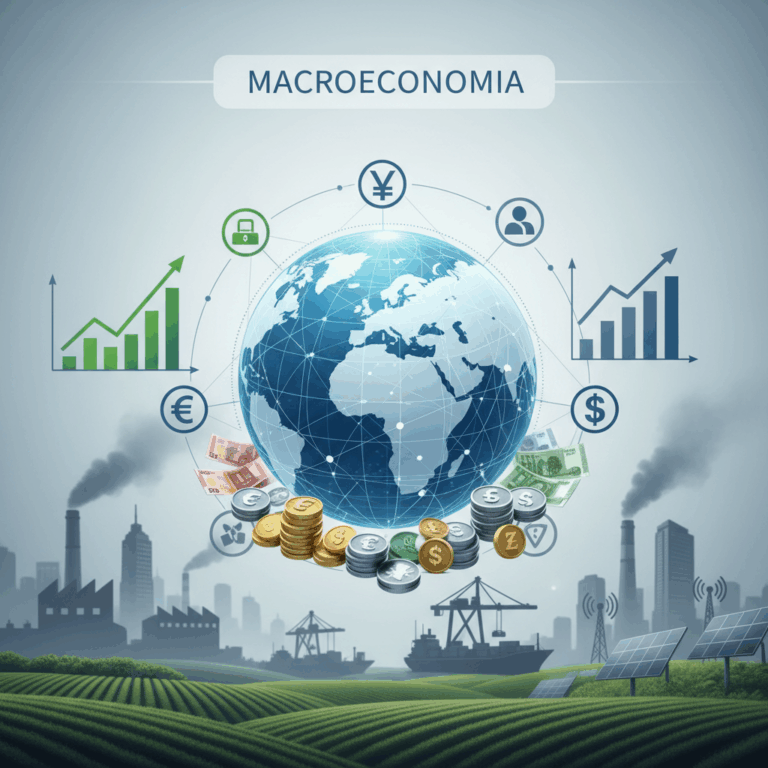
Definition and scope of macroeconomics
The macroeconomics it studies the global behavior of the economy, analyzing large aggregates such as production, prices and employment, in a country or region.
Its analysis addresses how sectors and markets interact, allowing us to understand trends and economic cycles, clearly differentiating ourselves from microeconomics.
General concept of macroeconomics
This economic branch looks at the economy as a whole, measuring the interaction between factors such as GDP, inflation and unemployment.
It uses qualitative and quantitative methods, as well as mathematical models, to evaluate the impact of public policies.
Its main function is to anticipate economic effects and support the design of efficient fiscal and monetary policies.
Differences between macroeconomics and microeconomics
Macroeconomics focuses on economic aggregates and global phenomena, while microeconomics studies individual agents such as households and businesses.
Both areas complement each other, but macroeconomics addresses large-scale problems such as inflation, unemployment and economic growth.
Microeconomics analyzes specific decisions, while macroeconomics examines how these decisions affect the national or international group.
Main macroeconomic indicators
Macroeconomic indicators are essential to understand the economic health of a country or region. They measure variables such as growth, prices and employment.
This data allows governments and analysts to evaluate policies and make decisions to improve stability and social well-being.
Gross Domestic Product (GDP)
GDP represents the total value of goods and services produced in a country during a specific period. It is the key measure of economic size.
Sustained GDP growth indicates economic expansion, while a decline may signal recession or structural problems.
GDP helps compare economies and plan policies that promote development and employment.
Inflation and its measurement
Inflation reflects the general increase in prices in the economy, affecting the purchasing power of the population.
Its most common measurement is through the Consumer Price Index (CPI), which monitors the variation of a representative basket of goods.
Controlling inflation is crucial to maintaining economic stability and avoiding market distortions.
Unemployment rate
The unemployment rate indicates the percentage of active people who seek employment but cannot find it, reflecting the employment situation.
High levels of unemployment affect social well-being and reduce the productive capacity of the economy.
This indicator is key to designing policies that promote job creation and improve labor inclusion.
Balance of payments, fiscal deficit and exchange rate
The balance of payments records all economic transactions between a country and the rest of the world, showing its international position.
The fiscal deficit appears when public spending exceeds income, which can impact the financial sustainability of the state.
The exchange rate is the relationship between national and foreign currency, affecting exports, imports and internal prices.
Application of macroeconomics in public policies
Macroeconomics allows us to design public policies that regulate the economy to promote stability, growth and social equity.
The analysis of large aggregates such as inflation and employment is vital to decide appropriate fiscal and monetary strategies.
Fiscal policies and their impact
Fiscal policies involve the administration of taxes and public spending, directly influencing economic activity.
An increase in public spending can stimulate growth, but it can also generate fiscal deficits if financing is not controlled.
Reducing taxes can encourage investment and consumption, although it must be balanced to avoid macroeconomic imbalances.
These policies seek to stabilize the economy, promote equality and improve social well-being in the medium and long term.
Monetary policies and tools
Monetary policies are directed by central banks to control the money supply and interest rates, impacting inflation and employment.
The management of interest rates influences credit and consumption; Low rates stimulate the economy, while high rates slow it down.
Other tools include open market operations and reserve requirements, which regulate liquidity and financial stability.
The effectiveness of these measures is crucial to maintaining price stability and promoting sustainable economic growth.
Importance of macroeconomics for the global economy
The macroeconomics it is key to understanding the functioning of the world economy, identifying problems and designing solutions that affect all countries.
Its study facilitates the understanding of how global economic variables interrelate, guiding decisions that seek stability and sustainable growth.
Diagnosis and solution of economic problems
Macroeconomics makes it possible to detect imbalances such as high inflation, unemployment or financial crises, which affect global economic health.
Analyzes structural and conjunctural causes, proposing appropriate fiscal and monetary policies to correct problems and promote recovery.
With models and data, it anticipates impacts of economic decisions, facilitating a rapid and efficient response to international challenges.
Effects of policies on social well-being
Macroeconomic policies directly influence it social welfare by affecting employment, prices, and income distribution.
An efficient policy can reduce poverty and inequality, improving the quality of life and social stability in different regions.
On the contrary, bad decisions generate economic uncertainty, loss of purchasing power and increased social exclusion.