Definition and components of GDP
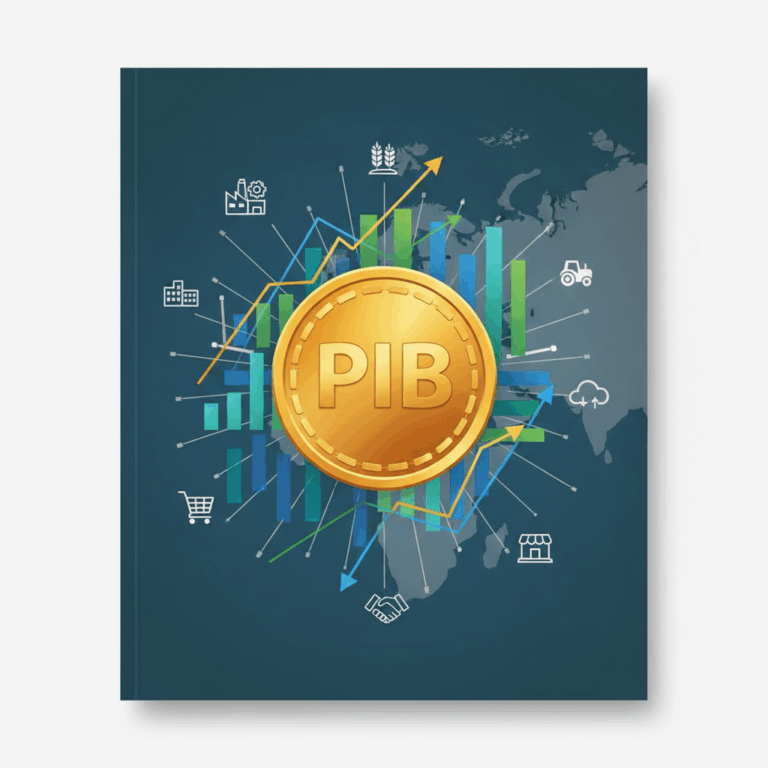
The Gross Domestic Product (GDP) is a key indicator that measures the monetary value of all final goods and services produced in a country. This calculation covers a certain period, generally a year or quarter.
GDP reflects economic activity within national borders and includes sectors such as agriculture, industry and services. Its measurement is essential to understand the economic health of a nation.
Basic concept of the Gross Domestic Product
GDP represents the sum total of domestic economic production during a specific period, considering only final goods and services to avoid double counting. It is the basis for evaluating economic performance.
Its monetary value is used to analyze economic growth or contraction, helping governments and companies make decisions based on the country's economic evolution.
It is measured within a national territory regardless of the nationality of the producers, thus differentiating itself from the Gross National Product that considers nationality.
Goods and services included in GDP
GDP includes final goods and services, excluding intermediate goods to avoid multiple registrations. This covers agricultural products, manufacturing, public and private services consumed or invested.
Services such as health, education and public administration are an integral part of GDP because they represent useful economic production for society. There are also activities of private and public companies.
Unreported illegal and economic activities are excluded, so GDP offers an approximation of the real total, but not an exhaustive record of the country's entire economy.
Methods to calculate GDP
The calculation of the GDP it is carried out using different methods that allow the economy to be evaluated from different perspectives. Each approach provides a complementary vision of the total produced.
These methods seek to ensure that the final monetary value accurately represents economic activity and facilitates analysis for public policies and investment decisions.
Value added approach
This method calculates the GDP adding the added values in all stages of production. The value of intermediate inputs is subtracted to avoid duplication in the count.
In addition, it is adjusted for indirect taxes and subsidies are deducted to correctly reflect the net value generated by economic activity.
It is a precise technique to measure the real contribution of each economic sector, from agriculture to services, facilitating sectoral comparisons.
Spending approach
The calculation from the expense consider the sum of private consumption, public spending, investment and the difference between exports and imports.
This method reflects the final demand for goods and services in the economy, showing how and where the resources produced are used.
It is widely used to analyze the impact of fiscal policies and variations in a company's consumption or investment.
Other complementary methodologies
In addition to the main approaches, there are methods that incorporate adjustments for revenue and production, as well as additional indicators to enrich the analysis.
These methods complement the basic figures, allowing a more detailed view of economic performance and helping to detect possible discrepancies.
Interesting fact
By combining different methods, the accuracy of GDP calculation is improved and statistical errors are reduced, providing a more reliable indicator for economic analysis.
Importance of GDP for a country
The GDP it is essential to measure economic growth, as it reflects the increase or decrease in the total value of goods and services produced in a country. It is a key indicator to understand economic health.
An increase in GDP is often associated with higher employment and a better quality of life, while a decline can indicate economic problems such as recession or stagnation. Thus, monitoring GDP helps evaluate the economy.
Economic growth indicator
GDP shows the rate at which a country's economy grows or contracts in certain periods, allowing positive or negative trends in economic production to be identified.
Sustained GDP growth is a sign of economic expansion, which usually translates into more job opportunities and an increase in the population's consumption capacity.
Furthermore, GDP monitoring allows governments and analysts to anticipate necessary changes in economic policies to stabilize or stimulate national development.
International comparison and decision making
GDP facilitates comparison between countries in terms of wealth and economic development, allowing a nation to be placed within the global context.
This comparison is decisive for foreign investments, trade negotiations and allocation of international resources, influencing national economic policy.
Governments also use GDP to design strategies and public policies that promote growth, stability, and improve overall economic conditions.
GDP limitations
The GDP it is an essential tool to measure economic activity, but it does not reflect fundamental aspects such as quality of life or social well-being.
Furthermore, it does not consider key factors such as wealth distribution or environmental impact, which limits its ability to show a complete picture of a country's progress.
Aspects not reflected by GDP
The GDP it does not measure inequality in income distribution, meaning that economic growth may not benefit the entire population equally.
It also does not include unregistered activities, such as the informal economy or unpaid domestic work, which are relevant to understanding economic reality.
Environmental impact and sustainability are also not captured in GDP, thus ignoring ecological costs and the depletion of natural resources.
Need for complementary indicators
To obtain a more complete vision of well-being, it is necessary to accompany it GDP with indicators such as the Human Development Index or measurements of poverty and inequality.
These complements allow us to evaluate social, environmental and quality of life aspects that GDP alone does not reflect, facilitating more comprehensive public policies.