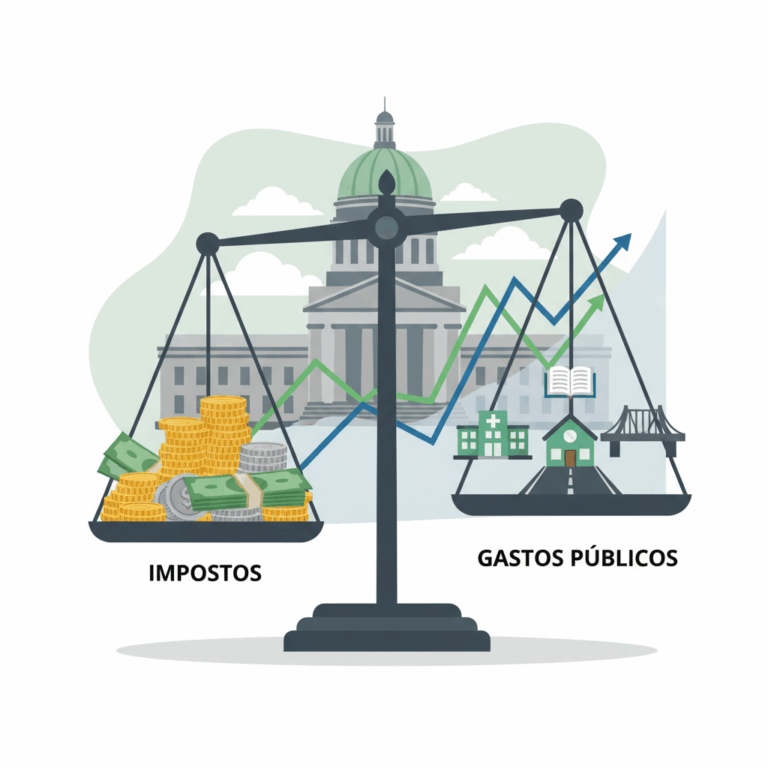
Instruments of fiscal policy
Fiscal policy mainly uses two instruments: taxes and public spending. These mechanisms allow the State to influence the economy directly and effectively.
Taxes regulate the financial capacity of citizens and companies, while public spending channels resources into strategic sectors to promote economic development.
These instruments are vital to control aggregate demand and respond to different economic situations, either by stimulating the economy or moderating its growth.
Taxes as an economic tool
Taxes constitute an essential source of income for the State, allowing it to finance public policies and basic services. Modifying tax rates affects disposable income and economic behavior.
By reducing taxes, the government can encourage consumption and investment, thus supporting economic activity in times of slowdown.
Instead, raising taxes can help curb excessive growth and contain inflation by adjusting demand.
Public spending and its impact
Public spending acts as an economic engine by injecting resources into sectors such as infrastructure, education and health, generating employment and improving the quality of life.
Increasing public spending can stimulate the economy during recessions, increasing demand and promoting productive activity.
However, uncontrolled overspending can cause budget imbalances and inflation, so your management must be careful and strategic.
Types of fiscal policies and their effects
Fiscal policies can take different forms to influence the economy, highlighting two main types: expansive and restrictive. Each seeks clear objectives in different economic contexts.
These approaches allow the government to act to stimulate growth or control phenomena such as inflation, balancing the economy and protecting social well-being.
Furthermore, the State plays a stabilizing role, using these policies to mitigate fluctuations and promote sustainable and balanced development.
Expansive fiscal policy and economic stimulus
Expansive fiscal policy is applied when the economy is weak or in recession. It consists of increasing public spending or reducing taxes to stimulate aggregate demand.
By injecting money through investments or reducing the tax burden, consumption and investment are encouraged, which generates employment and revives production.
This strategy seeks to reactivate economic growth and return stability to the labor market, reducing the negative impact of the slowdown.
Restrictive fiscal policy and inflation control
When the economy overheats, restrictive fiscal policy reduces spending or increases taxes to moderate demand and contain inflation.
Reducing the liquidity available in the economy helps avoid uncontrolled price increases, stabilizing the purchasing power of citizens.
These measures are essential to maintain macroeconomic balance and avoid bubbles that could trigger future crises.
The stabilizing role of the State
The State uses fiscal policy as a tool to smooth out economic fluctuations, acting preventively in the face of abrupt changes in activity.
By regulating public income and expenses, we seek to achieve sustained growth, stable employment and prices under control, guaranteeing economic stability.
This stabilizing role is key to avoiding prolonged crises and ensuring a favorable environment for development and social well-being.
Fiscal policy and social redistribution
Fiscal policy not only influences the economic cycle, but is also essential to reduce social inequalities. Through progressive taxes, the State can redistribute wealth.
Through collection and public spending aimed at social programs, the aim is to improve the well-being of the most vulnerable sectors, promoting greater equity in society.
Taxes and reduction of inequalities
Progressive taxes tax those with greater economic capacity more, allowing essential public services to be financed for those with fewer resources.
This income redistribution contributes to reducing social and economic gaps, strengthening social cohesion and sustainable development.
Furthermore, the efficient use of these resources in education, health and social protection expands opportunities and improves the quality of life of the entire population.
Objectives and functions of fiscal policy
Fiscal policy's main objective is to promote economic and social development through the management of public income and expenses. Its function is to balance growth, stability and equity.
Through appropriate measures, the State can promote job creation, ensure essential services and reduce inequalities, contributing to collective well-being.
Promotion of economic growth and employment
Fiscal policy drives economic growth through tax incentives and strategic spending, stimulating production and investment in various sectors.
By promoting infrastructure and education projects, direct and indirect jobs are generated, benefiting the economy and improving the quality of life of citizens.
Furthermore, maintaining a stable and predictable tax environment builds the confidence of investors and companies, facilitating long-term sustainable development.
Guarantee of essential services and social well-being
Through adequate collection and efficient distribution of public spending, fiscal policy ensures access to health, education and social protection for the entire population.
The State uses these resources to strengthen the welfare system, guaranteeing dignified and equitable conditions that favor social inclusion.
These essential services contribute to reducing poverty and improving the quality of life, supporting social cohesion and stability of the country.