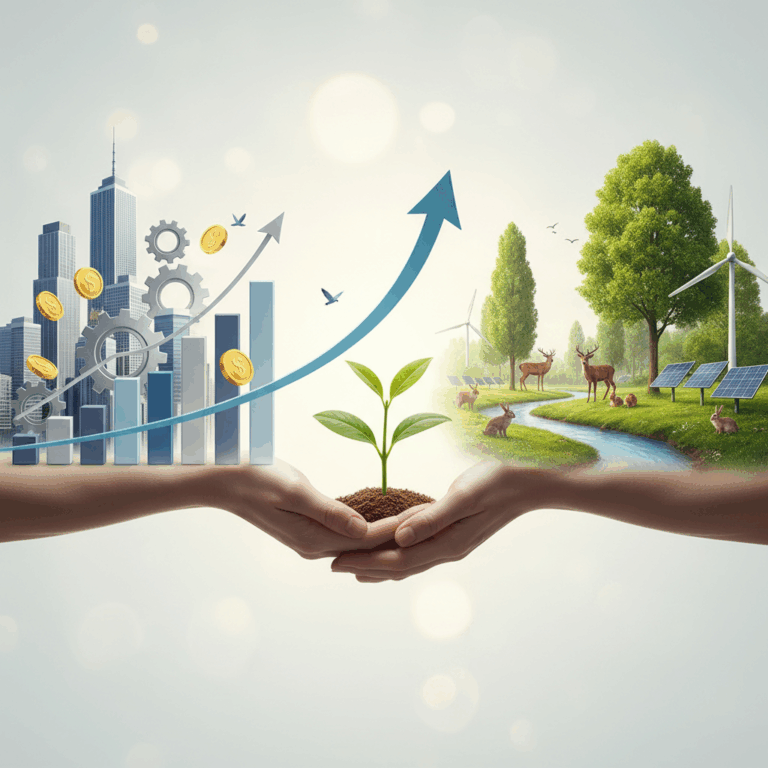
Fundamentals of the sustainable economy
The sustainable economy integrates economic growth, environmental preservation and social justice to create value without depleting natural resources.
This approach seeks to regenerate the environment while promoting broad social benefits, ensuring balanced and lasting development.
Its success depends on innovative and efficient strategies that allow progress without compromising the well-being of future generations.
Essential pillars: growth, environment and social justice
The fundamental pillars of the sustainable economy are economic growth, environmental protection and social justice, interdependent pillars.
Growth must be compatible with the conservation of natural resources and social equity to guarantee quality of life and sustainability.
Social justice ensures that economic benefits are distributed equitably, avoiding inequalities that affect sustainable development.
Innovation and efficient use of resources
Innovation is key to optimizing the use of resources, reducing waste and promoting technologies that support a circular economy.
Efficient use involves maximizing the value of the materials and energy used, encouraging practices that improve productivity without harming the environment.
This combination enhances the creation of green jobs and new sustainable business models, strengthening the economy and the environment.
Economic models aimed at sustainable development
Sustainable economic models seek to integrate financial growth with environmental conservation and social well-being, promoting balanced development.
These models drive innovation and the responsible use of resources, promoting value creation without compromising the future of the planet.
By adopting approaches such as the circular, impact and collaborative economy, more resilient and equitable systems are promoted.
Circular economy and its impact on reuse
The circular economy is based on reducing, reusing and recycling materials to minimize waste and maximize the efficiency of resource use.
This model generates opportunities for green businesses, drives innovation in durable products and favors the creation of sustainable jobs.
By closing production cycles, pressure on natural resources is reduced, helping to mitigate pollution and climate change.
Impact economy: social and environmental benefit
Impact economics measures success not only in financial terms, but by the social and environmental value generated by economic activities.
This approach promotes transparency, innovation and alliances between sectors to face environmental and social challenges.
Companies and organizations adopt goals that balance profitability with responsibility, improving collective well-being and environmental sustainability.
Collaborative economy and resource optimization
The collaborative economy encourages cooperation and the sharing of resources, avoiding excessive consumerism and waste.
Through platforms and collaboration agreements, access to goods and services is facilitated, increasing efficiency and reducing negative impacts.
This way of operating drives more responsible and sustainable habits, strengthening communities and promoting balanced economic growth.
Ecological limits and economic growth
Traditional economic growth faces limits due to the finitude of natural resources and the planet's ability to regenerate them.
It is crucial to recognize that the economy must operate within ecological limits to avoid irreversible damage and preserve future well-being.
Therefore, the sustainable economy seeks a balance where economic development does not compromise environmental and social health.
Ecological economy and balance with the planet
Ecological economics suggests that unlimited growth is not viable, recommending a balance between economic activity and ecological capacity.
This approach prioritizes innovation and efficiency to improve quality of life without expanding massive resource consumption.
Sustainable development is sought that respects natural limits, focusing on qualitative changes and comprehensive well-being.
Strategies for responsible economic growth
To achieve responsible economic growth, it is essential to promote technological innovation that optimizes resources and reduces negative impacts.
Efficiency in processes and products contributes to maximizing economic benefits while preserving the environment.
These strategies support development that does not compromise the well-being of future generations, promoting a sustainable balance.
Promotion of technological innovation and efficiency
Technological innovation drives the creation of solutions that improve efficiency in the use of resources and reduce environmental pollution.
The adoption of clean technologies and optimized processes allows costs to be minimized and economic and environmental value to be maximized.
Furthermore, innovation facilitates the development of green jobs and sustainable business models that strengthen the economy and protect the planet.
Priority to sustainable development over unlimited growth
Sustainable development prioritizes quality and balance instead of unlimited economic growth, respecting the ecological limits of the planet.
This vision promotes qualitative changes such as greater social well-being, innovation and efficiency, rather than uncontrolled quantitative easing.
Thus, progress is guaranteed that benefits society and takes care of natural resources, ensuring long-term viability.